

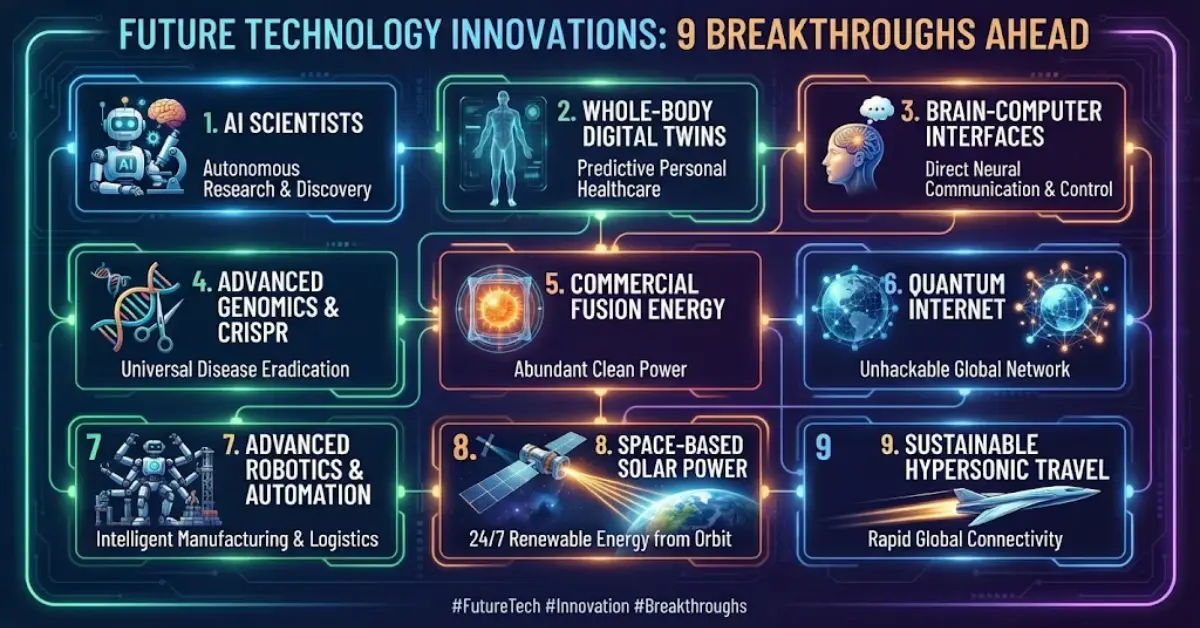
Future technology innovations are no longer ideas from science fiction. They are already moving from research labs into hospitals, factories, homes, and pockets. Artificial intelligence writes code and reads medical scans, solar panels power entire cities, and rockets are reused like airplanes.
In this guide, you will discover nine breakthroughs that will shape the next decade, how each one works in simple terms, and what it means for your work and daily life. Whether you are a student, a business owner, or simply curious, understanding these trends helps you make smarter decisions today.
Why Future Technology Innovations Matter
Technology shapes how we earn, learn, travel, and stay healthy. Every major leap, from the printing press to the smartphone, has changed economies and created entirely new careers. Today the pace is faster than ever, because many technologies now strengthen one another. Better chips make AI stronger, stronger AI speeds up drug discovery, and cheaper energy makes all of it more affordable.
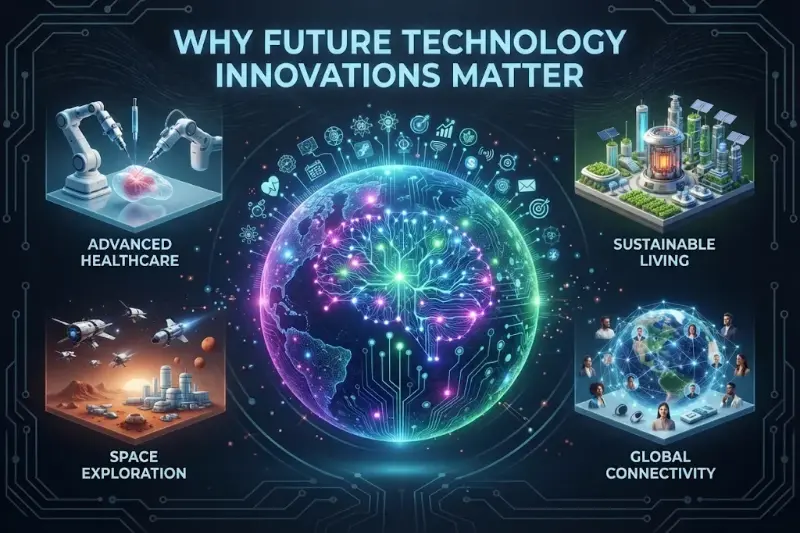
For individuals, following emerging technologies means spotting new career paths early. For businesses, it means finding efficiency, new products, and a competitive edge. For societies, it offers solutions to big problems such as climate change, disease, and resource shortages. The sections below cover the innovations most likely to define the coming years.
Future Technology Innovations at a Glance
The table below summarizes each breakthrough, its biggest benefit, and how close it is to everyday use. Timelines are general estimates and will vary by country and industry.
| Innovation | Biggest benefit | Stage today |
|---|---|---|
| Artificial intelligence | Faster work and smarter decisions | Already in daily use |
| Quantum computing | Solving problems classical computers cannot | Early research and pilots |
| Biotechnology | Personalized, preventive medicine | Growing clinical use |
| Clean energy and batteries | Low-cost, low-carbon power | Rapid expansion |
| Robotics and automation | Safer, more efficient work | Expanding across industries |
| Connectivity and smart cities | Real-time, connected services | Rolling out worldwide |
| Spatial computing | Immersive training and collaboration | Maturing |
| Space technology | Global coverage and new industries | Commercial growth |
| Cybersecurity | Safer data and trusted identity | Constantly evolving |
Artificial Intelligence and Generative AI
Artificial intelligence is the most visible of all future technology innovations. Modern AI systems can write text, create images, translate languages, summarize documents, and help programmers build software in a fraction of the usual time. Generative AI, in particular, has moved from experiment to everyday tool for millions of people.
The next stage is agentic AI: systems that do more than answer questions. They plan steps, use software tools, and complete multi-step tasks such as booking travel, analyzing a spreadsheet, or managing a support inbox. In healthcare, AI already helps doctors detect diseases earlier from scans. In education, it acts as a patient tutor that adapts to each student.
What to expect: smaller, faster models running directly on phones and laptops, stronger privacy controls, and AI built quietly into almost every app. People who learn to work alongside AI will have a clear advantage.
Quantum Computing
Classical computers use bits that are either 0 or 1. Quantum computers use qubits, which can exist in several states at once, allowing certain problems to be solved far faster. This does not mean quantum machines will replace your laptop. They will act as specialist tools for problems that overwhelm normal computers.
Promising uses include designing new materials and batteries, simulating molecules for medicine, optimizing logistics networks, and improving financial models. Researchers are also building post-quantum cryptography, a new generation of encryption that stays secure even against quantum attacks.
What to expect: steady progress in error correction and larger, more reliable machines, with early commercial value in chemistry, materials science, and optimization over the next several years.
Biotechnology and Gene Editing
Biotechnology is rewriting what medicine can do. Gene-editing tools such as CRISPR allow scientists to correct faulty DNA, and the first approved therapies for inherited blood disorders show that the idea works in real patients. Messenger RNA technology, made famous by vaccines, is now being tested against cancer, flu, and rare diseases.
AI is speeding this field up too. It can predict protein structures and suggest drug candidates in days instead of years. Add wearable sensors and home testing, and healthcare is shifting from treating illness to predicting and preventing it, with treatments tailored to each person’s genes.
What to expect: more personalized therapies, faster drug development, lower costs over time, and growing public debate about safety, access, and ethics.
Clean Energy and Next-Generation Batteries
The world is moving toward cleaner power, and technology is making the shift practical. Solar and wind are now among the cheapest sources of new electricity in many regions. The remaining challenge is storage: sun and wind are not constant, so we need batteries that last longer, charge faster, and cost less.
Solid-state batteries, sodium-ion cells, and grid-scale storage systems are all advancing quickly. Advanced nuclear designs, including small modular reactors, and next-generation geothermal are also being developed to provide steady, low-carbon power. Meanwhile, green hydrogen may help decarbonize steel, shipping, and heavy industry.
What to expect: electric vehicles with longer range, homes that store their own solar power, and smarter grids that balance supply and demand automatically.
Robotics and Automation
Robots are leaving the factory floor. Warehouse robots already move millions of packages, surgical robots assist with precise operations, and agricultural machines can spot weeds and water only the plants that need it. The newest wave is humanoid and general-purpose robots, designed to work in spaces built for people.
Combined with AI vision and language understanding, these machines can learn new tasks from demonstration instead of detailed programming. Autonomous vehicles and delivery drones follow the same trend, slowly expanding from pilot programs into regular service.
What to expect: automation will take over dangerous and repetitive work while creating demand for robot technicians, data specialists, and AI supervisors. Reskilling will be the key to a fair transition.
Advanced Connectivity, IoT, and Smart Cities
Faster networks are the invisible foundation of many future technology innovations. 5G is still expanding, and researchers are already working on 6G, which aims for far lower delay and the ability to connect huge numbers of devices at once. Satellite internet is also bringing reliable coverage to remote villages, ships, and aircraft.
On top of these networks sits the Internet of Things: billions of sensors in homes, vehicles, farms, and factories. Smart cities use this data to ease traffic, cut energy waste, monitor air quality, and respond to emergencies faster. A digital twin, a live virtual copy of a building or city, lets planners test ideas before spending a single dollar on construction.
What to expect: more connected devices, real-time services, and a growing need for strong data privacy rules.
Spatial Computing: AR, VR, and Mixed Reality
Augmented and virtual reality are maturing from gaming accessories into serious tools. Surgeons rehearse operations in 3D, engineers inspect machines through smart glasses, and students walk through ancient cities in a history lesson. Lighter headsets, sharper displays, and hand and eye tracking make the experience more natural every year.
Spatial computing blends digital content with the physical world, so you can place a virtual screen on your wall or see step-by-step repair instructions floating over a broken appliance. Combined with AI assistants, wearable glasses may eventually replace many smartphone tasks.
What to expect: practical uses in training, design, remote collaboration, and healthcare before mass consumer adoption.
Space Technology
Space is becoming more accessible. Reusable rockets have cut launch costs dramatically, and thousands of small satellites now provide internet, weather data, farming insights, and disaster monitoring. Governments and private companies are planning new missions to the Moon, with longer-term goals of building lunar bases and reaching Mars.
Space innovation also benefits life on Earth. Satellite imagery tracks deforestation and crop health, while navigation signals power everything from ride sharing to precision agriculture. Research into in-orbit manufacturing may even produce materials that are hard to make under gravity.
What to expect: lower launch prices, more commercial space services, and new industries built around orbit and the Moon.
Cybersecurity and Digital Trust
As more of life moves online, protecting data becomes essential. Attackers now use AI to craft convincing scams, so defenders are responding with AI that detects unusual behavior in seconds. Passkeys and biometric login are replacing weak passwords, and the zero-trust approach, which verifies every user and device every time, is becoming standard in companies.
Digital identity tools and tamper-resistant records can also help prove that photos, videos, and documents are real, an important defense against deepfakes and misinformation.
What to expect: security built into products by default, stronger identity checks, and greater demand for cybersecurity professionals.
Challenges and Ethical Questions
Every powerful technology brings risks. Society will need to address several issues as these innovations spread:
- Jobs and skills: automation will change many roles, so training and lifelong learning matter more than ever.
- Privacy: connected devices and AI collect large amounts of personal data that must be protected.
- Fairness: AI systems can repeat bias found in their training data unless they are tested carefully.
- Access: new medicines, energy, and connectivity should reach everyone, not only wealthy regions.
- Environmental cost: data centers and device manufacturing use energy and materials, so efficiency must improve.
Clear regulation, transparent design, and public education will help ensure innovation benefits people broadly.
How to Prepare for the Future of Technology
You do not need to be an engineer to benefit from future technology innovations. A few simple habits will keep you ready:
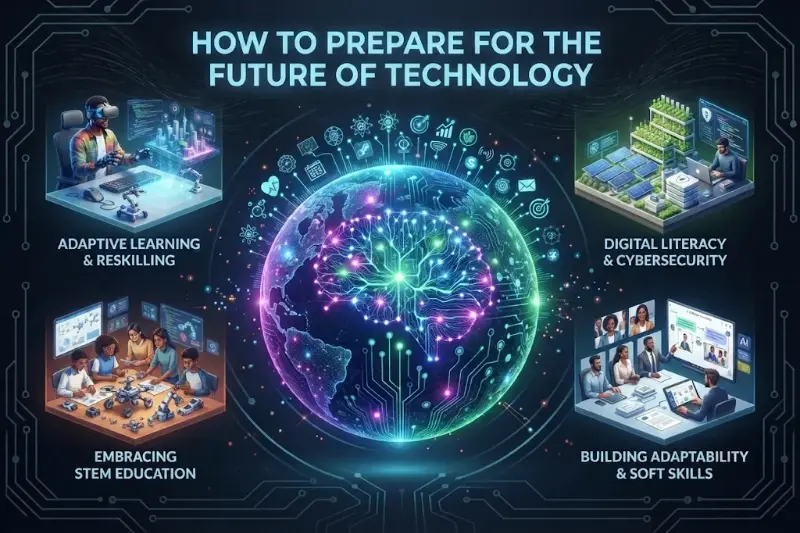
- Keep learning. Spend a little time each week on a new tool or skill, such as data basics, prompt writing, or digital marketing.
- Build human skills. Creativity, communication, critical thinking, and empathy are hard for machines to copy.
- Experiment early. Try new tools on small projects before committing money or time.
- Protect your data. Use passkeys or strong passwords, enable two-factor authentication, and update your devices regularly.
- Stay informed. Follow reliable science and technology news and question sensational claims.
Frequently Asked Questions
What are the most important future technology innovations?
Artificial intelligence, quantum computing, biotechnology, clean energy, robotics, advanced connectivity, spatial computing, space technology, and cybersecurity are widely seen as the areas with the biggest impact.
Will future technology take away jobs?
It will change many jobs and remove some tasks, but history shows new technology also creates new roles. Learning new skills is the best protection.
Which future technology will affect daily life first?
AI assistants and smarter connected devices are already part of daily life, followed by cleaner energy, electric transport, and personalized healthcare.
How can beginners learn about emerging technologies?
Start with free online courses, read trusted technology news, and practice with beginner-friendly tools. Small, regular steps work better than trying to learn everything at once.
Are future technologies safe?
Most can be used safely when companies follow strong security standards and governments set sensible rules. Public awareness and responsible design are essential.
Conclusion
Future technology innovations are shaping a world that is smarter, cleaner, and more connected. AI, quantum computing, biotechnology, clean energy, robotics, faster networks, spatial computing, space exploration, and stronger cybersecurity will each transform industries, and together they will reshape how we live and work.
The future will reward people who stay curious, keep learning, and use technology responsibly. Start small, follow the trends that matter to your goals, and you will be ready for what comes next.
