Introduction:
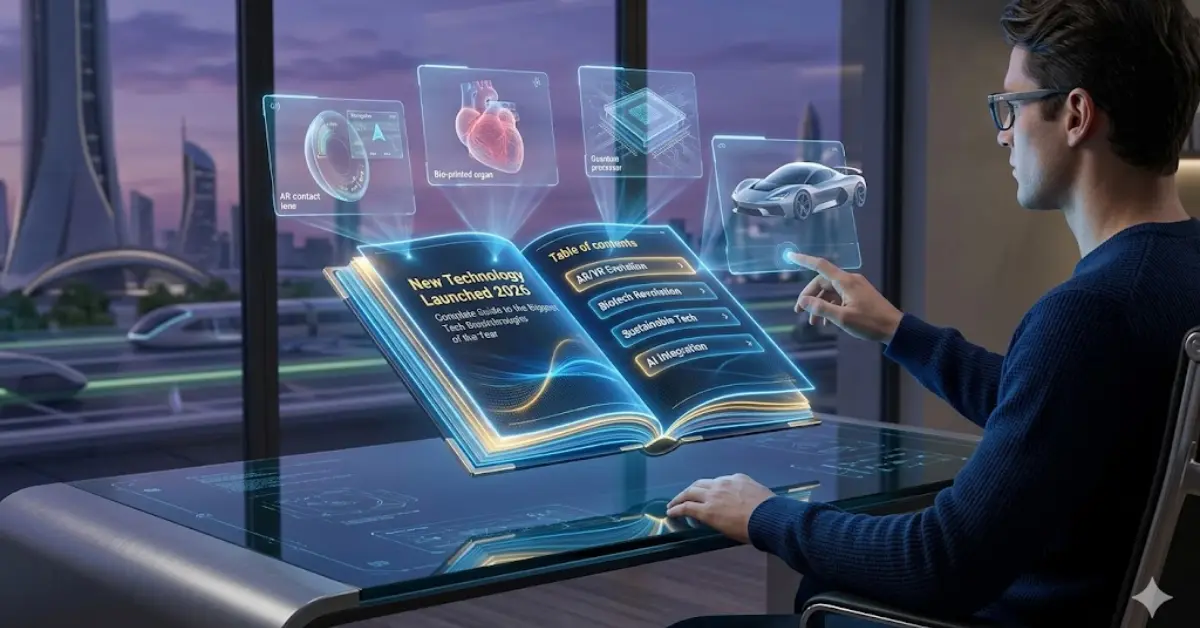
The year 2026 is not just another year in the tech calendar — it is a defining moment in human history. Experts and analysts across the globe are calling it the beginning of the "Physical AI Era", where artificial intelligence moves beyond our screens and into the real world. Robots, autonomous vehicles, personalized medicine, and even space computing are no longer science fiction — they are being launched and deployed right now. New Technology Launched 2026
Whether you are a tech enthusiast, a business professional, a student, or simply someone curious about the future, understanding the new technology launched in 2026 is essential. These breakthroughs will reshape how we live, work, communicate, and interact with the world around us.
In this comprehensive guide, we will walk you through the top new technologies of 2026, explain how they work, and explore why they matter for you and for the planet.
AI Agents: The New Digital Workers of 2026
One of the most significant new technologies launched in 2026 is the widespread deployment of AI Agents — intelligent software applications that can reason, decide, and act on your behalf.

Unlike traditional AI tools that answer questions or generate content, AI agents can autonomously:
- Purchase goods online
- Negotiate contracts
- Plan and book travel
- Manage business workflows
- Conduct scientific research and experiments
These agents are powered by large language models and are now being integrated into everyday applications. In 2026, we are beginning to see their gradual entry into daily life — in customer service, healthcare management, logistics, and personal productivity.
For businesses, AI agents mean reduced operational costs and faster decision-making. For individuals, they mean a digital assistant that truly works for you — not just with you.
Why this matters: AI agents are predicted to multiply innovative capacity in science and engineering, enabling faster breakthroughs in medicine, climate research, and more.
Neuralink Brain Chip: Restoring Human Senses
Among the most talked-about new technologies of 2026 is Neuralink's brain-computer interface chip, which has now progressed to a groundbreaking new milestone: restoring sight to the blind.
Neuralink, the neurotechnology company founded by Elon Musk, is developing implantable chips that connect the human brain directly to computers. In 2026, the company is working on a device aimed at giving blind individuals the ability to perceive visual information through neural stimulation.
Key Features of Neuralink's 2026 Technology:
- Tiny chip implanted in the brain via minimally invasive surgery
- Reads and transmits neural signals wirelessly
- Enables direct brain-to-computer communication
- Designed to restore lost sensory and motor functions
Beyond restoring sight, brain-chip technology holds promise for treating paralysis, depression, epilepsy, and neurological disorders. As clinical trials expand, this technology could soon become a standard medical treatment.
Why this matters: The brain chip is not just a gadget — it is a medical revolution that could restore quality of life for millions of people worldwide.
Neuromorphic Computing: The Brain-Inspired Chip Revolution
Alongside brain chips, 2026 has also seen major progress in neuromorphic computing — a new approach to chip design that mimics the structure and function of the human brain.
BrainChip, a global leader in this space, launched its AKD2500 silicon development project in February 2026. This $2.5 million initiative aims to integrate its next-generation Akida 2.0 neuromorphic architecture into silicon using TSMC's cutting-edge 12-nanometer process. Prototype silicon is expected in Q3 of 2026.
Why Neuromorphic Chips Are Game-Changers:
- Ultra-low power consumption — processes data like the brain, using far less energy than traditional chips
- Real-time processing — ideal for edge devices like smartphones, drones, and IoT sensors
- AI-friendly architecture — designed to run machine learning models efficiently
As the energy demands of AI continue to skyrocket, neuromorphic chips offer a sustainable path forward. Industry analysts predict commercial neuromorphic solutions will hit the market very soon.
Sodium-Ion Batteries: The End of Lithium Dependence
Energy storage has always been one of the biggest challenges in the transition to clean energy. In 2026, sodium-ion batteries are emerging as a revolutionary alternative to traditional lithium-ion batteries.
MIT Technology Review has listed sodium-ion batteries among its Top 10 Breakthrough Technologies of 2026, and for good reason.
Why Sodium-Ion Batteries Are Better:
- Made from abundant, low-cost materials (essentially salt)
- Cheaper to manufacture than lithium-ion batteries
- Safer — less risk of fire or explosion
- Longer-lasting for large-scale grid storage
- Ideal for affordable electric vehicles (EVs) in emerging markets
CATL (Contemporary Amperex Technology Co., Ltd.), the world's largest battery manufacturer, has announced a major commercial deployment plan for sodium-ion batteries in 2026. This move is expected to dramatically lower the cost of EVs and renewable energy storage globally.
Why this matters: Sodium-ion batteries could accelerate the global shift to clean energy, making electric vehicles affordable for billions of people who currently cannot afford them.
Space Data Centers: Computing Beyond the Atmosphere
One of the most futuristic new technologies launched in 2026 is the concept of space-based data centers. Yes — computing in orbit around Earth.
Space offers unique advantages for data processing:
- Superior thermal conditions (natural cooling in space)
- Abundant solar energy with no day/night cycle limitations
- Reduced latency for global satellite communications
The collaboration between Nvidia and StarCloud has already resulted in the first AI model trained in orbit, proving that space computing is not just theoretical — it is real and it works.
As rocket launch costs continue to fall (thanks to companies like SpaceX and Rocket Lab), the economics of space data centers are becoming increasingly viable. In 2026, the first commercial space data center projects are being planned, and this could fundamentally change the internet infrastructure of the future.
Autonomous Vehicles and Trucks: Transforming Transportation
Self-driving technology has been a promise for over a decade — but in 2026, it is finally delivering on that promise at scale.
Driverless vehicles are now operating 24/7 in many major cities across the United States and China, providing safe, reliable, and accessible transportation without a human driver.
2026 Milestones in Autonomous Vehicles:
- Robotaxis operating commercially in major metro areas
- Autonomous trucks beginning to transform long-haul logistics
- New sodium-ion battery technology reducing the cost of EV fleets
- Cities beginning to redesign urban spaces with fewer private cars in mind
The economic impact is enormous. Autonomous trucking alone is expected to dramatically reduce logistics costs, making goods cheaper for consumers and more competitive for businesses.
Why this matters: Fewer cars, less congestion, lower emissions, and safer roads — autonomous vehicles could be one of the biggest quality-of-life improvements in modern history.
AI-Generated Video: The VEO 3 Revolution
The world of content creation was transformed in 2026 by AI video generation technology, with Google's VEO 3 leading the charge.
VEO 3 can generate hyper-realistic video content entirely from text prompts, with a level of visual fidelity that is increasingly difficult to distinguish from real footage. In 2026, AI video production has reached technical maturity, transforming industries like:
- Film and television production
- Advertising and marketing
- Education and e-learning
- Social media content creation
- Gaming and virtual reality
Meta has also announced plans to fully automate ad creation and delivery by the end of 2026, using AI to generate entire advertising campaigns from just a product image and a budget.
Why this matters: AI video is democratizing content creation, allowing small businesses, independent creators, and educators to produce high-quality visual content at a fraction of the previous cost.
Personhood Credentials: Verifying Humanity in the AI Age
As AI-generated content becomes indistinguishable from human-created content, a new challenge has emerged: How do we know who — or what — we are talking to online?
In 2026, major institutions and tech companies are developing personhood credentials — digital identity systems that verify the human authenticity of online users.
How Personhood Credentials Work:
- Users complete a one-time in-person identity verification
- They receive a cryptographically secure digital identity token
- This token can be used to prove they are a real human in sensitive online interactions (banking, voting, healthcare, etc.)
- The system protects privacy while ensuring authenticity
This technology is especially critical as hyper-realistic avatars and AI agents become more common. Governments, financial institutions, and social platforms are all exploring personhood credentials as a standard for trusted online interaction.
Personalized Gene Editing: Medicine at the DNA Level
2026 has witnessed a landmark moment in medical history. Baby KJ, when just seven months old, became the first person to receive a personalized gene-editing treatment — a custom-designed therapy built specifically for his unique genetic condition.
This breakthrough, highlighted by MIT Technology Review, has opened the door to a new era of bespoke medicine — where treatments are designed for individual patients at the DNA level.
What Personalized Gene Editing Means:
- Custom drugs designed for a single patient's genetic profile
- Potential to cure previously untreatable genetic diseases
- Clinical trials now being planned
- FDA approval for personalized gene therapies expected within the next few years
This is not a distant future technology — it is happening now, in 2026, and it represents one of the most profound shifts in the history of medicine.
Satellite-Direct Mobile Connectivity and 10G Networks
The way we connect to the internet is also being transformed by new technology in 2026.
Satellite-direct connectivity — led by Starlink — allows mobile phones to connect directly to satellites without requiring a cell tower. This means:
- True global internet coverage, including in deserts, oceans, and remote mountains
- Emergency connectivity in disaster zones
- Digital access for the 3+ billion people currently without reliable internet
At the same time, 10G networks are being actively tested in China, promising internet speeds and reliability far beyond what current 5G networks offer. These technologies together will make high-speed connectivity a universal human right rather than a privilege.
Next-Generation Nuclear Power
Nuclear power has long been a controversial topic, but 2026 is seeing a renaissance in next-generation nuclear reactor designs that are cleaner, smaller, and safer than ever before.
New reactor designs highlighted by MIT Technology Review include:
- Molten salt reactors — using liquid fuel for higher efficiency and safety
- TRISO fuel reactors — using ceramic-coated fuel particles that cannot melt down
- Small Modular Reactors (SMRs) — compact reactors that can be deployed rapidly and affordably
These new nuclear technologies offer zero greenhouse gas emissions and could play a critical role in decarbonizing the global energy grid alongside solar and wind power.
Generative AI in Robotics: The Physical AI Era Begins
Perhaps the most transformative trend of 2026 is the fusion of generative AI with robotics, creating machines that can learn, adapt, and perform tasks in the physical world.

Thanks to AI trained on video and spatial data, robots can now:
- Understand and navigate complex real-world environments
- Learn new tasks by watching human demonstrations
- Generate 3D virtual environments for training and simulation
- Operate in domestic settings, not just industrial factories
This has been clearly showcased at CES 2026, where robots capable of multitasking in home environments were demonstrated. The "Physical AI Era" — where AI leaves our screens and enters our daily physical world — has officially begun.
Frequently Asked Questions (FAQs)
Q1: What is the biggest new technology launched in 2026?
A: The biggest breakthroughs of 2026 include AI agents, Neuralink brain chips, sodium-ion batteries, neuromorphic computing, and autonomous vehicles. Together, they represent the beginning of the "Physical AI Era."
Q2: Are sodium-ion batteries available in 2026?
A: Yes. CATL, the world's largest battery manufacturer, has announced a major commercial deployment of sodium-ion batteries in 2026, making them available for electric vehicles and energy storage.
Q3: What is a Neuralink brain chip?
A: Neuralink's brain chip is an implantable device that connects the human brain to computers, allowing it to read and send neural signals. In 2026, it is being developed to restore sight to blind individuals.
Q4: What is the Physical AI Era?
A: The Physical AI Era refers to the transition of AI from digital screens into physical robots and real-world systems, making AI a part of our everyday physical environment.
Q5: How does personhood credential technology work?
A: Personhood credentials use cryptography and initial in-person identity verification to issue secure digital tokens that prove a user is a real human being online, protecting against AI impersonation.
Q6: Will 10G networks be available worldwide in 2026?
A: 10G networks are currently being tested in China in 2026. Widespread global availability is expected in the coming years.
Conclusion:
The new technology launched in 2026 is not a preview of what is coming — it is the reality of what is already here. From AI agents managing our workflows to brain chips restoring lost senses, from space data centers to personalized gene therapies, the pace of technological innovation has never been faster.
2026 is the year the future arrived. The question now is not whether these technologies will change the world — they already are. The real question is: Are you ready to embrace them?
Stay informed, stay curious, and keep exploring — because the next breakthrough might be just around the corner.